A crackling marine radio during an inlet crossing. A chartplotter displaying the blue screen of death. A radar that worked perfectly last season but now shows nothing but static. When boat electronics fail, the immediate instinct is often to rip out the old and install the new. But that impulse can cost thousands of dollars unnecessarily. Understanding when professional boat electronics service makes more financial and practical sense than replacement requires technical knowledge, diagnostic expertise, and familiarity with how marine systems actually fail in saltwater environments.
The marine electronics repair versus replacement decision isn’t always straightforward. Unlike consumer electronics that typically get discarded when they malfunction, quality marine equipment represents a significant investment designed for professional-grade service and repair. A Garmin 8617 chartplotter carries a $6,000 price tag. Furuno radar systems often exceed $10,000. When these systems fail, a $300-800 repair suddenly looks far more attractive than a complete replacement.
The True Cost of Premature Replacement
Boat owners frequently replace functioning electronics because of simple, repairable issues. A corroded antenna connection gets misdiagnosed as a failed VHF radio. A loose NMEA 2000 network backbone terminator causes intermittent chartplotter failures. A GPS antenna with water intrusion leads someone to conclude their entire navigation system needs replacement.
The financial impact extends beyond the hardware cost. Complete replacement means:
- New mounting hardware and bracket fabrication
- Rewiring and network reconfiguration
- Disposal of functioning equipment
- Learning curves with different interfaces
- Potential loss of waypoints and customized settings
- Installation labor costs that often match or exceed equipment prices
A professional South Florida marine installer can diagnose the actual failure point, often discovering that what appeared to be a catastrophic system failure is actually a $150 connector replacement or a software update. This diagnostic capability alone justifies the service call cost, even when repair ultimately isn’t recommended.
When Marine Electronics Repair Makes Perfect Sense
Power Supply and Connection Issues
The saltwater environment attacking South Florida boats creates electrical havoc. Voltage drops from corroded terminals, water intrusion in junction boxes, and failing battery connections account for approximately 60% of apparent electronics failures. These issues present identical symptoms to complete unit failure: intermittent operation, unexpected shutdowns, or complete non-function.
Professional yacht electronics troubleshooting begins with power verification. A quality technician measures voltage at the unit under load, checks for voltage drop across connections, and inspects for galvanic corrosion. A Raymarine MFD that won’t power on often simply needs its power connection cleaned and properly sealed, not a $4,000 replacement display.
Antenna and Transducer Problems
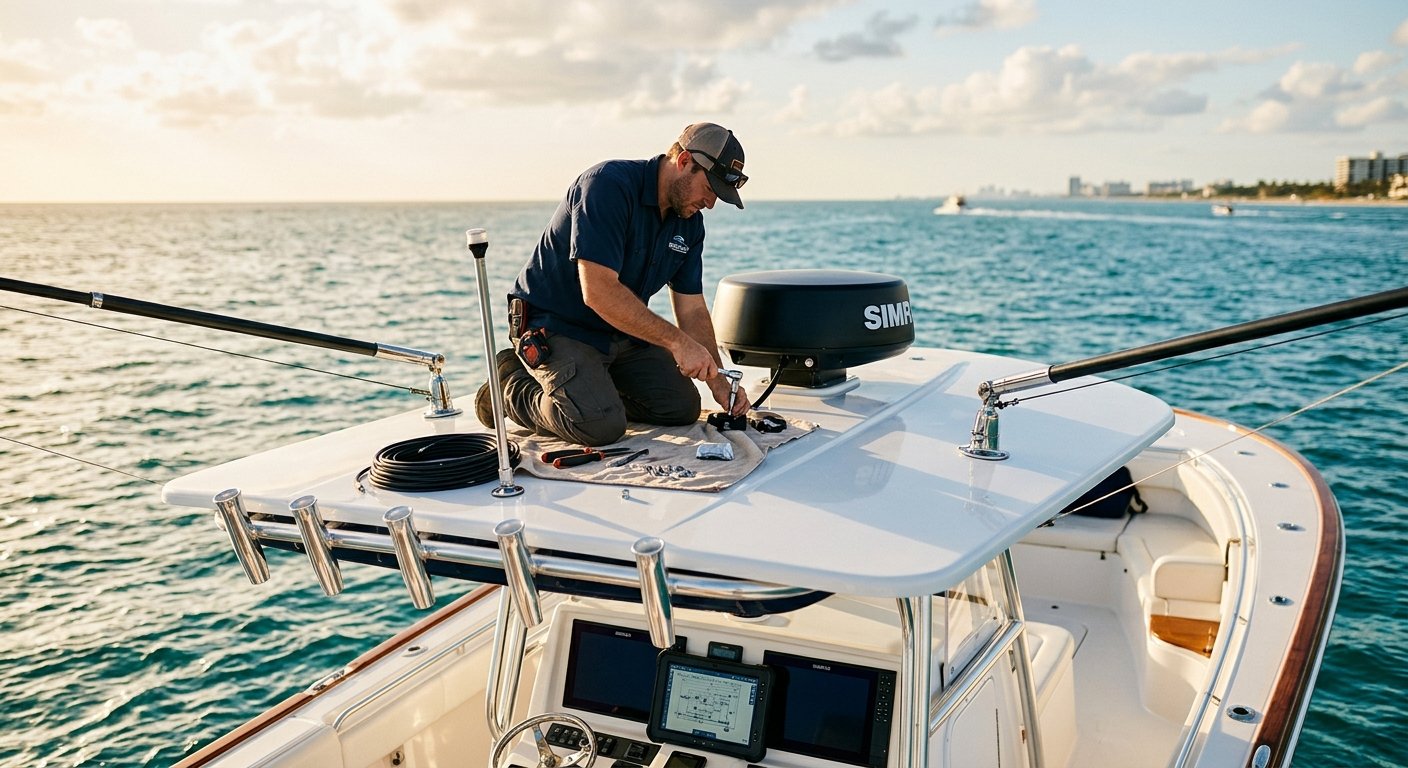
Marine GPS repair frequently involves nothing more than replacing the antenna. GPS antennas fail from lightning strikes, UV degradation, and water intrusion. The $200 antenna fails while the $3,000 chartplotter behind it remains perfectly functional. Similarly, boat radar repair often requires addressing antenna motor failures or waveguide issues rather than replacing the entire radar processor and display system.
VHF marine radio repair commonly traces back to antenna issues rather than radio failures. A corroded antenna connection at the masthead creates high SWR (standing wave ratio) that prevents transmission while still allowing reception. Boat owners assume the radio has failed, when actually a $75 antenna or $30 cable connector solves the problem entirely.
Software Corruption and Configuration Errors
Modern marine electronics run sophisticated operating systems that can become corrupted. A chartplotter that freezes during startup, displays error messages, or loses functionality after a botched software update doesn’t need replacement—it needs proper reflashing and configuration. Manufacturers provide authorized service centers with factory software images and diagnostic protocols that restore units to full functionality.
NMEA 2000 network issues frequently masquerade as individual device failures. An improperly terminated backbone, incorrect power supply, or conflicting device addresses can cause seemingly random failures across multiple displays and sensors. A qualified technician resolves these integration issues without replacing any hardware.
Component-Level Repairs
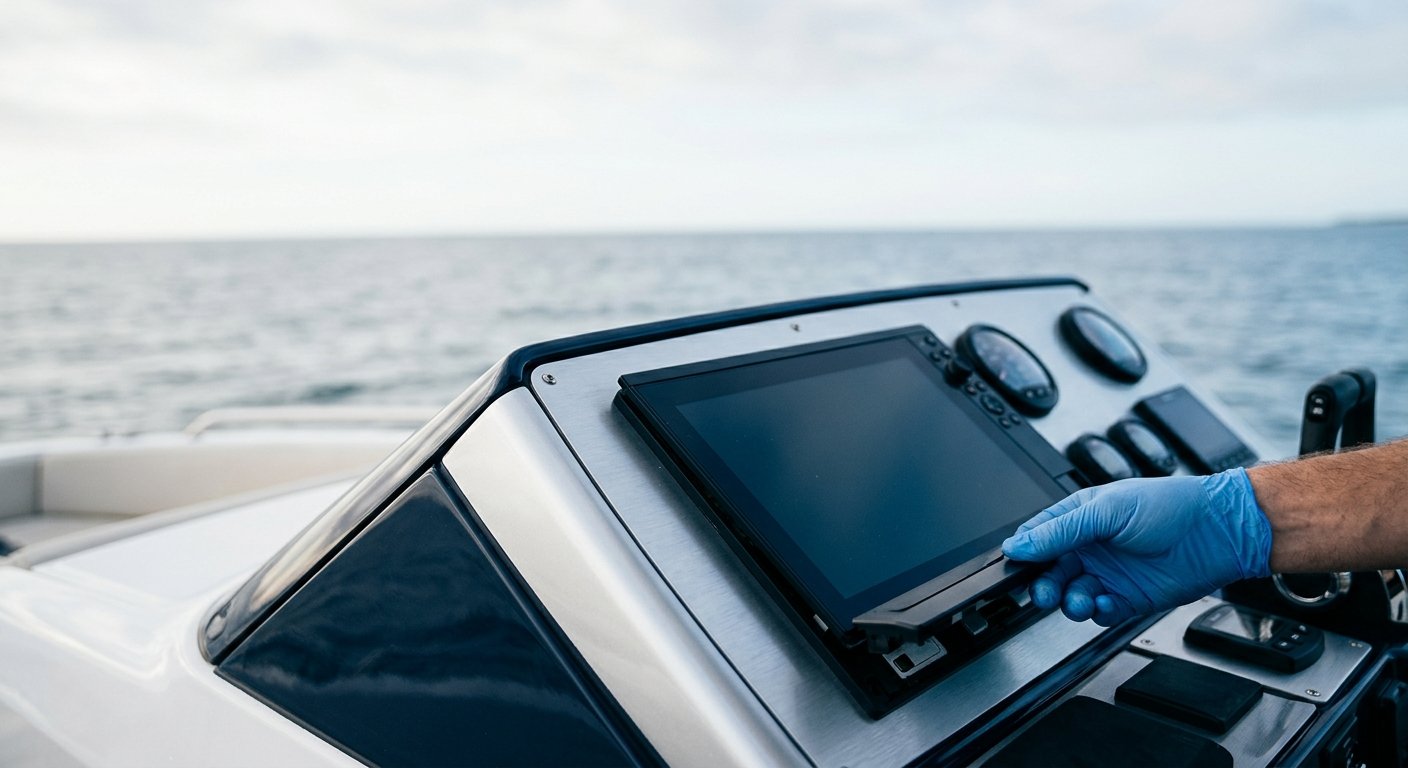
Quality marine electronics use modular construction that enables component replacement. A chartplotter with a failing touchscreen doesn’t require a new chartplotter—the display panel can be replaced. A radar with a burnt power supply board can receive a new board for a fraction of replacement cost. Autopilot drive units can be rebuilt rather than replaced.
These repairs require factory training and authorized service center status. Marine Electronics Installer (MEI) maintains manufacturer authorizations that provide access to genuine parts, technical documentation, and calibration procedures unavailable to unauthorized repair shops.
When Replacement Actually Makes More Sense
Despite the repair advantages, specific scenarios favor complete replacement:
Technology Obsolescence
Units manufactured before 2015 often lack parts availability. Manufacturers discontinue support for older models, making repairs impossible or economically unfeasible. A 12-year-old Garmin 4012 chartplotter with screen failure might cost $800 to repair, but that investment goes into aging technology without modern features, faster processors, or current mapping capabilities.
Navigation systems predating NMEA 2000 integration can’t communicate with modern sensors and displays. Repairing these isolated systems means continuing with outdated technology that can’t participate in integrated vessel networks. The repair cost might be reasonable, but the opportunity cost of missing modern capabilities becomes significant.
Lightning Strike Damage
Direct or near-direct lightning strikes often cause catastrophic damage across multiple systems. The electrical surge damages processors, memory chips, display components, and circuit boards simultaneously. While repairable in theory, the combined cost of replacing multiple internal components often exceeds 80% of new unit cost. At that threshold, replacement makes financial sense, particularly considering the warranty that accompanies new equipment.
Saltwater Intrusion
Complete saltwater submersion or prolonged water intrusion causes corrosion that continues destroying components even after initial repairs. Water that breaches a display case corrodes circuit board traces, crystallizes inside connectors, and degrades component leads. A unit that suffered significant water intrusion may work after initial repair but develop new failures as hidden corrosion progresses.
Mechanical Damage
Physical impacts that crack display housings, shatter screens, or deform chassis structures often create secondary damage that makes repair impractical. While a cracked screen alone might be repairable, the impact force that cracked the screen frequently damages internal boards and components in ways that only become apparent later.
The Diagnostic Advantage
Professional boat electronics service begins with comprehensive diagnostics that determine actual failure causes. This process includes:
- Power supply verification under load conditions
- Network communication testing across NMEA connections
- Signal strength measurement for antennas and transducers
- Software version verification and corruption checks
- Component-level testing of suspected failures
- Environmental factor assessment (corrosion, water intrusion, heat damage)
These diagnostics provide the information needed for intelligent repair-versus-replace decisions. A technician can quote exact repair costs, explain failure causes, project remaining service life, and recommend whether repair makes economic sense for your specific situation.
The South Florida Marine Environment Factor
Marine electronics repair in South Florida faces unique environmental challenges. The combination of intense UV exposure, high humidity, frequent lightning activity, and warm saltwater accelerates degradation in ways that northern climates don’t experience. Equipment that might last 15 years in freshwater lakes often shows significant age at seven years in the ocean environment between St. Lucie Inlet and Fort Lauderdale.
This accelerated aging means repair decisions must consider not just immediate failure causes but also overall system condition. A five-year-old Simrad system showing power supply failure might merit repair. A ten-year-old system with the same failure, showing additional signs of corrosion and UV damage, likely approaches the replacement threshold.
Offshore fishing to the Bahamas and Gulf Stream passages place additional stress on electronics through shock, vibration, and spray exposure. Equipment on these vessels requires more frequent service and encounters failures earlier than electronics on coastal cruisers. These usage patterns inform repair recommendations.
Making the Right Decision for Your Vessel
Several factors should guide your repair-versus-replace decision:
Equipment Age: Units under five years old generally favor repair unless damage is catastrophic. Units over ten years old tilt toward replacement unless repair costs are minimal.
Repair Cost Ratio: When repair exceeds 50% of replacement cost, replacement often makes better financial sense, particularly for units already past mid-life.
Feature Requirements: If your current system lacks capabilities you need—better charts, faster processing, touchscreen functionality, network integration—factor upgrade value into the replacement decision.
System Integration: Repairing one component in an integrated network maintains compatibility and preserves your existing interface knowledge and waypoint data.
Parts Availability: Manufacturer support status directly impacts long-term serviceability. Equipment with discontinued parts support should be replaced rather than temporarily repaired.
Frequently Asked Questions
How much does marine electronics repair typically cost?
Diagnostic fees generally run $125-200, applied toward repair if you proceed. Simple repairs like antenna replacement or connector service cost $150-400. Component-level repairs like display replacement or board swaps range from $400-1200. Complex repairs requiring multiple components approach $1500-2000, at which point replacement often makes more sense.
How long do marine electronics repairs take?
Simple repairs completed on-site take hours. Component replacement requiring parts ordering takes 3-10 days depending on parts availability. Units requiring factory service take 2-4 weeks. A qualified marine electronics repair shop provides realistic timelines during diagnosis.
Are rebuilt or refurbished marine electronics reliable?
Factory-refurbished units from manufacturers carry warranties and meet original specifications. Third-party rebuilds vary in quality. For critical navigation and communication equipment, factory-refurbished or new units provide better reliability assurance than unknown-quality rebuilds.
Can I repair marine electronics myself?
Basic troubleshooting like checking connections and power supplies is appropriate for boat owners. Component-level repair requires specialized tools, diagnostic equipment, manufacturer documentation, and technical training. Improper repairs void warranties and can create safety hazards. NMEA-certified technicians have the training and authorization for proper service.
How can I prevent marine electronics failures?
Regular maintenance prevents many failures: inspect connections quarterly for corrosion, verify proper sealing at all cable entries, keep equipment cleaned of salt spray, ensure adequate ventilation, maintain proper voltage at the panel, and schedule professional inspection annually. Preventive maintenance costs far less than emergency repairs.
Get Expert Diagnosis for Your Marine Electronics
The repair-versus-replace decision requires accurate diagnosis from technicians with manufacturer training and proper diagnostic equipment. Marine Electronics Installer provides professional boat electronics service for vessels throughout South Florida, with factory authorization from major manufacturers and NMEA certification for proper installation and repair standards.
Whether your chartplotter displays error codes, your radar shows intermittent targets, or your VHF radio won’t transmit, professional diagnosis identifies the actual problem and provides realistic options. Don’t assume expensive replacement is necessary until qualified technicians examine your system.
Contact Marine Electronics Installer at (772) 634-6055 or visit the Stuart office at 7892 SW Jack James Dr, Stuart, FL, 34997. Schedule a diagnostic evaluation that provides the technical information you need for confident decisions about your marine electronics investment.