Garmin marine electronics represent a substantial investment in your vessel’s safety, navigation capability, and fishing effectiveness. However, even the most advanced Garmin chartplotter or radar system will underperform—or fail prematurely—if improperly installed. In South Florida’s demanding saltwater environment, from the Gulf Stream currents off Jupiter to the challenging conditions at St. Lucie Inlet, professional Garmin marine installation isn’t a luxury; it’s a necessity for reliability and safety.
NMEA-certified installation ensures your Garmin equipment integrates seamlessly with your vessel’s existing systems while meeting manufacturer specifications that protect your warranty. More importantly, proper installation practices account for the unique challenges South Florida boaters face: intense UV exposure, saltwater corrosion, lightning vulnerability, and the critical need for reliable electronics during offshore passages to the Bahamas or beyond.
Why Professional Garmin Marine Installation Matters
The difference between a professionally installed Garmin system and a DIY or amateur installation becomes apparent the first time you encounter challenging conditions. Professional marine electronics installation addresses factors many boat owners don’t initially consider until problems emerge.
Factory-trained technicians understand that Garmin systems require precise NMEA 2000 backbone configurations, proper power supply isolation, and careful routing of cables away from interference sources. A chartplotter mounted without considering sun glare angles becomes unreadable during critical navigation moments. Radar systems installed without proper grounding create electrical hazards and performance issues.
In South Florida’s saltwater environment, improper installations accelerate corrosion at connection points. A single unsealed wire junction exposed to moisture can compromise an entire network. According to the Florida Fish and Wildlife Conservation Commission’s boating safety guidance, electrical system failures represent a significant cause of on-water emergencies—failures often traced to improper installation practices.
NMEA 2000 Network Configuration
Modern Garmin systems communicate via NMEA 2000 networks, which function like a nervous system for your boat’s electronics. This standardized protocol allows chartplotters, autopilots, VHF radios, engines, and sensors to share data seamlessly. However, network architecture requires specific technical knowledge:
- Proper backbone termination with 120-ohm resistors at both ends
- Correct drop cable lengths to prevent signal degradation
- Power supply isolation to prevent voltage fluctuations
- Strategic device addressing to avoid communication conflicts
- Marine-grade connectors with proper IP67 ratings for water resistance
An improperly configured NMEA 2000 network may function initially but develop intermittent issues as connections corrode or expand under heat. These problems often appear at the worst possible times—during nighttime navigation through crowded channels or when weather deteriorates offshore.
Critical Installation Considerations for South Florida Conditions
South Florida’s marine environment presents unique installation challenges that differ significantly from freshwater or northern coastal conditions. Professional installers account for these regional factors in every Garmin marine installation.
Saltwater Corrosion Prevention
Saltwater aggressively attacks unprotected connections and inferior materials. Professional installations use marine-grade tinned copper wiring throughout—not automotive-grade wire that corrodes rapidly in saltwater environments. Every connection point receives proper sealing with heat-shrink tubing and dielectric grease formulated for marine applications.
Display mounting hardware must be 316-grade stainless steel rather than 304-grade, which shows rust staining within months in South Florida’s salt air. Transducer installations require specialized marine sealants that remain flexible under temperature variations while preventing water intrusion that causes wood cores to rot.
Lightning and Electrical Protection
South Florida experiences some of the highest lightning strike frequencies in the United States. According to National Weather Service data, Florida averages more than one million lightning strikes annually. Vessels represent elevated conductors in open water, making proper grounding essential.
Professional Garmin installations incorporate comprehensive grounding strategies that protect both equipment and occupants. This includes proper bonding of all electronic components to a vessel’s ground plane, installation of appropriate transient voltage surge suppressors, and strategic cable routing that minimizes lightning vulnerability. Antenna mounting locations require careful evaluation to reduce strike probability while maintaining signal effectiveness.
Display Positioning and Visibility
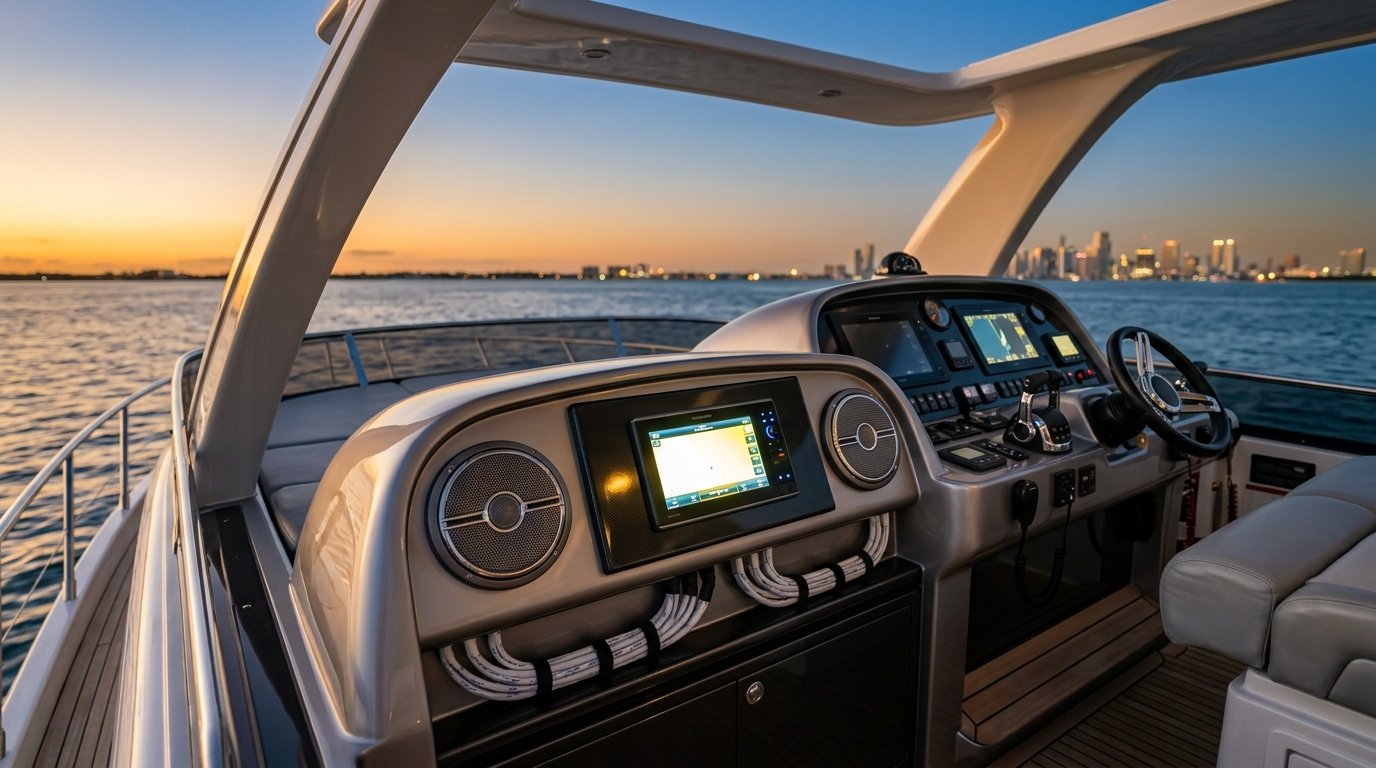
South Florida’s intense sunlight creates visibility challenges even for high-brightness Garmin displays. Professional installers evaluate sight lines from both seated and standing helm positions, accounting for sun angles throughout the day. A chartplotter perfectly visible at the dock may become unreadable when running east at dawn or west during afternoon returns from the Gulf Stream.
Console angles, overhead hardtop reflections, and dashboard glare all factor into optimal mounting positions. Multi-function display installations require strategic placement that allows quick reference without diverting attention from navigation responsibilities. For offshore fishing vessels, redundant displays at flybridge and lower helm stations need synchronized configurations that maintain consistency regardless of operating station.
Essential Garmin Systems for South Florida Boating
Garmin offers extensive product lines designed for specific boating applications. South Florida conditions and typical boating activities influence which systems provide the greatest value and safety benefits.
Chartplotter and GPS Navigation
Garmin GPSMAP series chartplotters form the foundation of modern marine navigation systems. These displays integrate GPS positioning, electronic charting, radar, sonar, and vessel system monitoring. For South Florida boaters making Bahamas crossings, preloaded BlueChart g3 cartography provides detailed coverage of the Abacos, Bimini, and Exumas.
Professional installation ensures GPS antennas receive clear sky views without obstruction from hardtops or radar domes that degrade position accuracy. This matters particularly when navigating narrow inlet channels like St. Lucie Inlet or Hillsboro Inlet, where precise positioning prevents grounding on shifting sandbars.
Radar Systems
Garmin Fantom solid-state radar provides collision avoidance capability and weather detection critical for South Florida boating. Unlike magnetron-based systems, solid-state radar delivers instant-on capability without warm-up delays and features MotionScope technology that highlights moving targets.
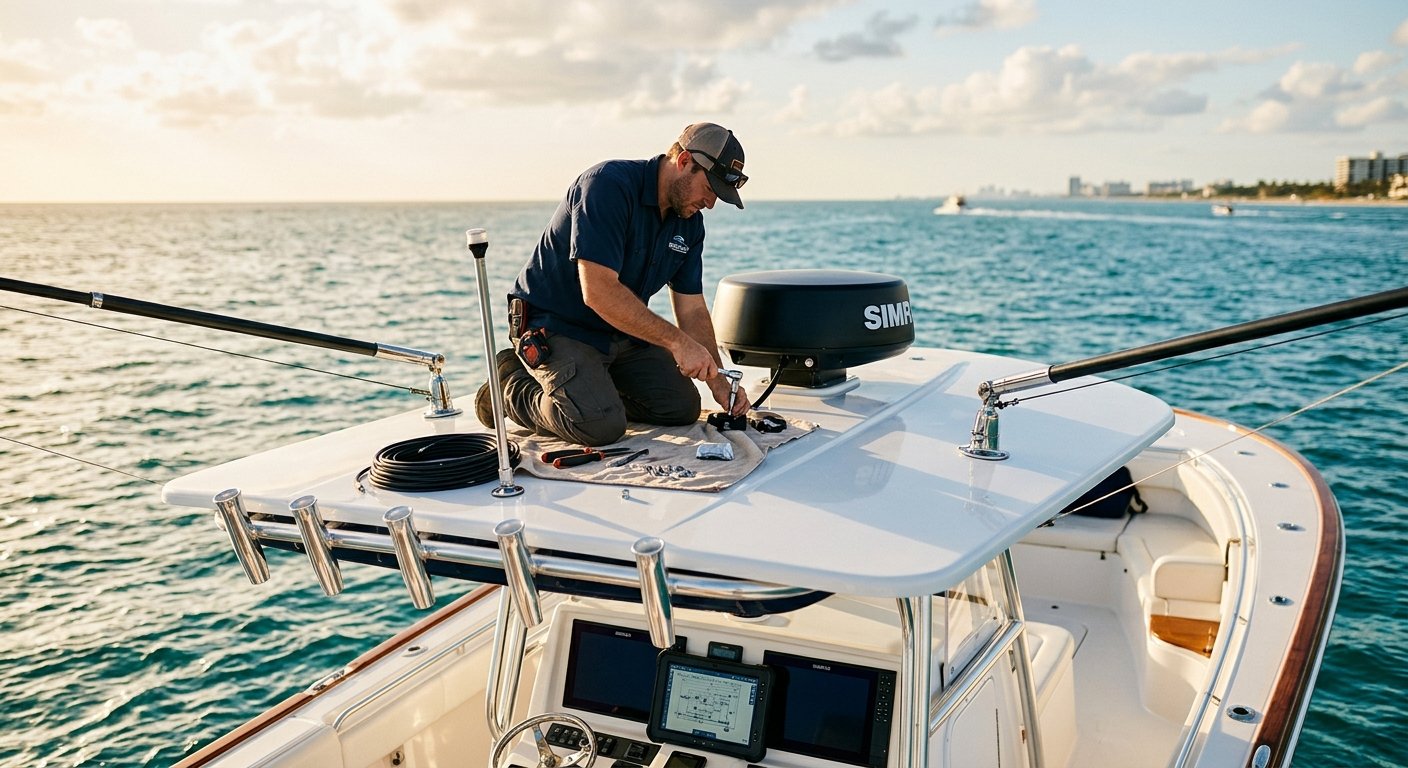
Radar installation requires precise mounting to maintain proper horizon alignment. Even slight angular misalignment causes ground clutter that obscures nearby targets. Cable runs between radar scanner and display must maintain minimum bend radius specifications to prevent signal loss. Professional installations include proper integration with chartplotter displays for overlay capabilities that enhance situational awareness.
Fish Finding Technology
For offshore fishing enthusiasts targeting wahoo off Jupiter or sailfish in the Gulf Stream, Garmin’s advanced sonar technology provides competitive advantages. CHIRP traditional sonar, ClearVü scanning sonar, and SideVü imaging deliver detailed bottom structure visualization and fish identification.
Transducer installation dramatically affects performance. Through-hull installations provide optimal performance for offshore vessels but require precise hull deadrise angle calculations and expert fiberglass work. Transom-mount installations need exact positioning to avoid turbulence and cavitation that create signal interference. Professional installers understand these nuances and recommend appropriate solutions based on hull design and operational profiles.
Integration with Existing Marine Electronics
Most vessels already have some marine electronics before Garmin installations. Successful integration requires understanding compatibility issues and communication protocols across different manufacturers and system vintages.
Older instruments may use NMEA 0183 rather than NMEA 2000 protocols, requiring gateway devices for network communication. VHF radios, autopilots, and engine monitoring systems all need proper integration to maximize functionality. A correctly configured system allows your Garmin chartplotter to display AIS vessel traffic, send DSC distress calls through your VHF radio, and control your autopilot—creating a unified operational environment.
This integration complexity explains why professional marine electronics installation delivers value beyond simple equipment mounting. Factory-trained technicians understand the technical specifications across product lines and can troubleshoot compatibility issues that would leave DIY installers frustrated.
The Installation Process: What to Expect
Professional Garmin marine installation follows systematic processes that ensure reliability and longevity. Understanding these steps helps boat owners appreciate the value of expert service.
Pre-Installation Consultation and Planning
Installation begins with comprehensive assessment of your vessel and boating requirements. This evaluation considers your typical operating area, fishing versus cruising focus, single versus dual helm configurations, and existing electronics infrastructure. Discussions about future expansion plans ensure installations accommodate growth without requiring complete system rebuilds.
Licensed and insured professionals provide detailed installation proposals outlining equipment specifications, labor requirements, and timeline expectations. This planning phase identifies potential complications before work begins, preventing surprises during installation.
Proper Cable Management and Routing
Professional installations emphasize proper cable routing that protects against chafe, maintains separation between power and signal cables, and allows future service access. Cables run through conduits where possible, secured at appropriate intervals to prevent movement during vessel operation.
Power supply connections receive particular attention, with properly sized wire gauges, appropriate circuit protection, and clean connections to distribution panels. Ground connections use large-gauge wire with proper crimped terminals—never twist-and-tape connections that corrode quickly in marine environments.
System Configuration and Testing
After physical installation, comprehensive system configuration ensures all devices communicate properly and display accurate data. This includes calibrating compasses, configuring alarms, setting up waypoints and routes, and verifying radar alignment. Testing procedures verify every function operates correctly before completion.
Professional installers provide operational training that helps boat owners understand their new systems’ capabilities. This education ensures you maximize your investment and operate equipment confidently.
Maintenance and Long-Term Reliability
Even expertly installed Garmin systems require periodic maintenance to ensure continued reliability in South Florida’s aggressive marine environment. Professional service includes inspection of connections for corrosion, verification of proper system operation, and software updates that provide enhanced functionality and security improvements.
According to guidance from the National Marine Electronics Association, annual electronics system inspections help identify developing issues before they cause failures. This preventive approach proves particularly valuable for vessels making extended offshore passages where equipment reliability directly impacts safety.
Frequently Asked Questions
How long does professional Garmin marine installation typically take?
Installation duration varies based on system complexity and vessel configuration. A basic chartplotter installation on a center console may require one day, while comprehensive multi-display systems with radar, autopilot, and advanced fish-finding technology on larger vessels can require several days. Factory-trained technicians provide accurate time estimates during pre-installation consultations after assessing your specific requirements and vessel layout.
Can I install Garmin marine electronics myself to save money?
While Garmin markets some products for DIY installation, professional installation provides significant advantages that justify the investment. Improperly installed systems may void warranties, create safety hazards, underperform, or fail prematurely due to incorrect configurations. In South Florida’s challenging saltwater environment, amateur installations typically develop problems within the first season that require professional correction—often costing more than proper installation would have initially.
Do Garmin electronics require regular software updates?
Yes, Garmin regularly releases software updates that improve functionality, add features, enhance security, and update cartography. Professional service includes periodic software maintenance that ensures your systems operate with current versions. Some updates can be performed by owners with technical comfort, but complex multi-device networks benefit from professional update services that verify proper operation across all integrated components.
How do I choose between different Garmin chartplotter models?
Chartplotter selection depends on your vessel size, typical boating activities, desired features, and budget. NMEA-certified installers provide consultative guidance based on experience with different models in South Florida conditions. Factors include screen size appropriate for viewing distances, processing power for radar integration, sonar compatibility, and networking capabilities. Professional consultation ensures you select equipment that matches your requirements without overpaying for unused capabilities.
What warranty coverage applies to professionally installed Garmin systems?
Garmin provides manufacturer warranties on their equipment, typically ranging from one to three years depending on product line. Professional installation performed by factory-trained, NMEA-certified technicians ensures compliance with warranty requirements. Many installation issues that would void manufacturer warranties are prevented through proper professional installation techniques, protecting your investment in both equipment and installation labor.
Trust MEI for Your Garmin Marine Installation
Your vessel represents a significant investment deserving of professional-grade electronics installation that prioritizes safety, reliability, and performance. Marine Electronics Installers combines NMEA-certified expertise with deep knowledge of South Florida boating conditions to deliver Garmin installations that perform flawlessly whether you’re navigating Roosevelt Bridge channel markers, fishing offshore structure in 200 feet of water, or making Bahamas crossings from Fort Lauderdale to Bimini.
Our factory-trained technicians understand the technical complexities of modern Garmin systems and the environmental challenges of South Florida’s saltwater conditions. We serve boat and yacht owners throughout the region, from Stuart to Fort Lauderdale, with professional marine electronics installation backed by proper licensing and insurance.
Contact Marine Electronics Installers at (772) 634-6055 or visit our Stuart location at 7892 SW Jack James Dr, Stuart, FL, 34997 to discuss your Garmin installation requirements. Let us provide the consultative expertise and technical precision your vessel deserves for reliable, safe operation in South Florida waters and beyond.