The 53-mile crossing from Lake Worth Inlet to West End is deceptively challenging. What begins as a routine offshore passage can quickly become a test of your vessel’s electronics when weather deteriorates, currents shift, or navigation systems fail. For South Florida boaters heading to the Bahamas for extended cruising—whether for a week at the Abacos or months island-hopping through the Exumas—properly prepared marine electronics aren’t optional equipment. They’re your lifeline when VHF radio reception fades, GPS accuracy matters most, and radar becomes essential for navigating sudden squalls between islands.
Extended Bahamas cruising demands more from your boat electronics than weekend coastal trips. You’ll encounter challenging navigation through shallow banks where one-meter depth accuracy means the difference between safe passage and running aground. You’ll rely on communication systems when you’re 50 miles from the nearest marina. Your chartplotter needs to function flawlessly when identifying narrow cuts between islands. This comprehensive preparation guide covers everything needed to ensure your marine electronics perform reliably throughout your Bahamas adventure.
Understanding Bahamas-Specific Electronic Requirements
Bahamas cruising presents unique challenges that expose weaknesses in inadequately prepared boat navigation systems. The shallow waters, coral heads, and constantly shifting sandbars require navigation precision that standard coastal equipment may not deliver. GPS accuracy within three meters works fine for offshore fishing, but threading through a cut at Warderick Wells demands chart plotters with enhanced positioning and up-to-date Bahamas cartography.
South Florida marine installers familiar with Bahamas cruising emphasize several critical factors. First, your chartplotter must include detailed Bahamas charts with regular updates—these waters change after major storms, and outdated cartography has led to numerous groundings. Second, redundancy becomes essential. When you’re anchored at Shroud Cay with the nearest technician three islands away, having backup systems prevents a failed GPS from ending your cruise prematurely.
Chart Selection and Updates
Choosing appropriate charts for Bahamas navigation requires understanding the limitations of different cartography sources. Explorer charts remain the gold standard for Bahamas cruising, offering the most detailed and frequently updated information for navigating shallow waters. Your marine GPS installation should include these specialized charts alongside standard NOAA charts.
Equally important is ensuring your chartplotter has sufficient memory and processing power to handle high-resolution Bahamas cartography. Older systems often struggle with detailed charts, causing lag time that creates dangerous situations when making real-time navigation decisions in challenging waters. A NMEA certified installer can assess whether your existing system has adequate capacity or requires upgrading before departure.
Communication Systems for Extended Cruising
Reliable communication transforms from convenience to necessity once you leave South Florida waters. VHF radio serves as your primary communication tool for monitoring weather, contacting marinas, coordinating with other cruisers, and requesting assistance. However, standard VHF installations adequate for coastal boating often prove insufficient for extended Bahamas cruising.
Proper marine electronics installation for Bahamas cruising includes mounting your VHF antenna at the highest practical point to maximize range. Height equals range with VHF transmission—every foot of elevation increases your communication distance. Professional yacht electronics installation ensures proper antenna mounting, quality coaxial cable with minimal signal loss, and secure connections that withstand the constant motion and salt spray exposure of offshore passages.
Beyond VHF: Satellite Communication Options
While VHF handles most communication needs within the Bahamas chain, extended cruising benefits significantly from satellite communication capability. Satellite phones or text messaging devices like Garmin inReach provide communication beyond VHF range, weather forecast access, and emergency assistance capability anywhere in the Bahamas.
These systems integrate with modern boat navigation systems through NMEA 2000 networks, allowing position sharing with emergency contacts and weather routing directly to your chartplotter. For cruisers planning extended stays in remote areas like the southern Exumas or Crooked Island, satellite communication isn’t luxury equipment—it’s prudent safety preparation.
Radar Installation and Configuration
Many South Florida boaters question whether radar justifies the investment for Bahamas cruising. The answer depends on your cruising style and risk tolerance. If you’re willing to wait out weather and never travel during reduced visibility, basic navigation equipment may suffice. However, experienced Bahamas cruisers recognize that marine radar installation provides critical safety capabilities that dramatically expand your operational envelope.
Afternoon thunderstorms develop rapidly over the Bahamas banks, sometimes materializing within 30 minutes. Radar allows you to track these weather cells, identify safe routes around severe weather, and make informed decisions about anchorage security as squall lines approach. Beyond weather tracking, radar helps identify other vessels, navigate in fog or darkness, and locate landmasses when visual navigation becomes challenging.
Radar Technology Selection
Modern marine radar installation offers two primary technologies: pulse radar and solid-state digital radar. Pulse radar systems provide longer range and perform well in rough conditions, making them ideal for serious offshore work and longer Bahamas crossings. Solid-state digital radar offers excellent close-range performance, lower power consumption, and instant-on capability without warm-up time.
For Bahamas cruising, many boaters favor solid-state systems for their reliability, reduced power consumption during extended anchoring, and excellent performance detecting rain cells and nearby vessels. A qualified marine electronics installation professional can recommend appropriate radar based on your vessel size, power availability, and specific cruising plans.
Power Management and Solar Integration
Extended cruising in the Bahamas tests your electrical systems more severely than day trips from South Florida marinas. You’ll run electronics continuously—chartplotter, radar, autopilot, VHF radio, refrigeration—while generator run-time decreases to preserve fuel and maintain anchorage tranquility. This creates power demands that many boats’ charging systems cannot sustain for multi-week cruises.
Proper preparation includes calculating your daily power consumption and ensuring adequate charging capacity through solar panels, wind generators, or sufficient battery capacity for your cruising style. Modern boat navigation systems with NMEA 2000 connectivity can monitor battery status, solar input, and power consumption in real-time, allowing proactive power management before critical systems shut down.
Marine-Grade Solar Installation
Solar panels have revolutionized extended cruising by providing silent, maintenance-free charging that keeps house banks topped off during Bahamas stays. However, marine solar installation requires more than mounting residential panels on deck. Marine-grade panels withstand salt spray, provide flexible mounting solutions for curved surfaces, and include proper charge controllers that integrate with marine electrical systems.
Professional yacht electronics installation ensures solar systems connect properly to NMEA 2000 networks for monitoring, include appropriate overcurrent protection, and use marine-rated wiring that resists corrosion in the harsh saltwater environment. Undersized or improperly installed solar systems fail precisely when you need them most—during extended periods away from shore power.
Redundancy and Backup Systems
Professional South Florida marine installers emphasize redundancy for Bahamas cruising because single-point failures that merely inconvenience coastal boaters can become serious safety concerns when you’re 60 miles from the nearest repair facility. Redundancy doesn’t necessarily mean duplicating every system, but rather ensuring navigation capability continues despite individual component failures.
At minimum, redundancy should include a handheld GPS with spare batteries, paper charts covering your cruising area, a handheld VHF radio, and basic compass navigation capability. More comprehensive approaches include dual chartplotters on separate power circuits, backup depth sounder, and redundant autopilot systems for extended offshore passages. The specific redundancy level appropriate for your vessel depends on boat size, cruising plans, and crew experience.
Autopilot Systems for Extended Passages
Hand-steering across the Gulf Stream and through multi-hour passages between islands creates crew fatigue that degrades decision-making precisely when navigation demands peak attention. Quality autopilot systems transform extended Bahamas cruising by reducing crew workload, maintaining more efficient courses, and allowing helmsmen to focus on navigation, weather monitoring, and boat systems rather than constant steering.
Marine electronics installation for autopilot systems requires careful attention to compass placement, hydraulic or mechanical steering integration, and proper calibration for your vessel’s characteristics. Undersized or incorrectly installed autopilots struggle in following seas or strong currents, actually increasing crew workload as helmsmen constantly override inadequate system performance. Professional installation ensures your autopilot has adequate capacity for your vessel and sea conditions encountered during Bahamas passages.
Pre-Departure Testing and System Verification
Even perfectly installed boat navigation systems require verification before extended cruising. Pre-departure testing should occur weeks before your planned departure—not the morning you leave—allowing time to address any problems discovered during testing. This testing process evaluates not just whether systems power on, but whether they perform correctly under realistic operating conditions.
Comprehensive testing includes verifying GPS accuracy by comparing multiple receivers, confirming radar detects targets at expected ranges, checking VHF radio transmission and reception, validating autopilot performance through various courses and sea states, and ensuring all NMEA 2000 network devices communicate properly. A NMEA certified installer can perform professional system verification that identifies potential problems before they become offshore emergencies.
Addressing South Florida Environmental Challenges
Boats kept in South Florida waters face continuous assault from saltwater, humidity, and intense UV exposure that degrades marine electronics over time. Preparing for extended Bahamas cruising requires addressing corrosion, inspecting connections, and replacing compromised components before departure.
Pay particular attention to antenna connections, which frequently corrode in South Florida’s environment despite appearing intact externally. Corroded connections cause intermittent problems that worsen offshore—VHF range decreases, GPS signals drop, radar performance degrades. Professional marine electronics installation includes proper sealing techniques, dielectric grease application, and marine-grade connectors that resist corrosion better than standard components.
Integration and NMEA 2000 Networks
Modern boat navigation systems achieve their full potential through proper integration via NMEA 2000 networks. These digital networks allow your chartplotter, radar, autopilot, AIS, depth sounder, wind instruments, and other devices to share data seamlessly, creating an integrated system greater than the sum of individual components.
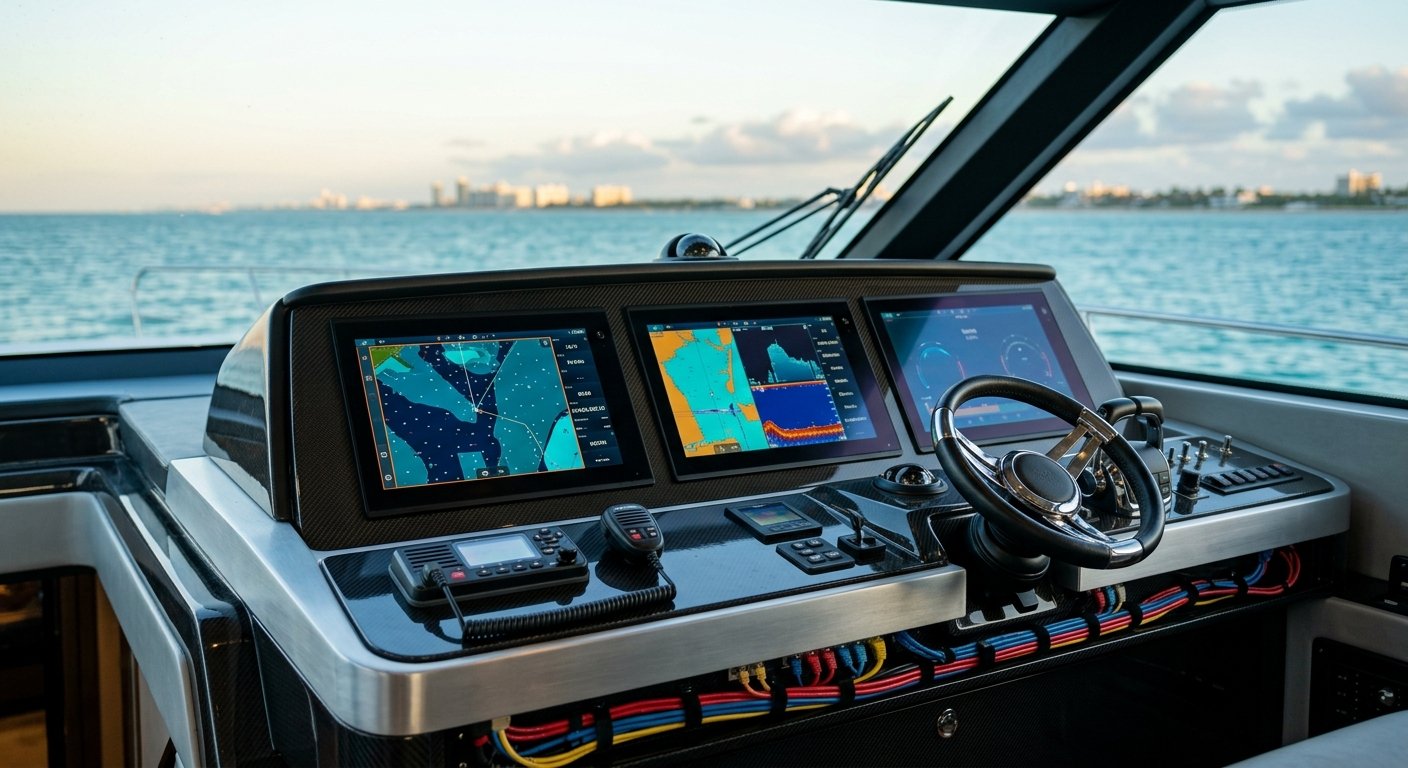
Your chartplotter can display radar overlay, AIS targets, depth information, and wind data simultaneously. Your autopilot can use GPS and wind data to maintain courses more efficiently. Your VHF radio can share GPS position for DSC distress calls automatically. However, these capabilities require proper network design, quality backbone cables, correct termination resistors, and appropriate power supply—technical details that separate professional yacht electronics installation from amateur attempts.
Frequently Asked Questions
How far in advance should I prepare my electronics for Bahamas cruising?
Begin preparation at least 8-12 weeks before departure. This timeline allows for equipment ordering, professional installation, thorough testing, and addressing any problems discovered during shakedown runs. Last-minute preparations often result in untested systems or departure delays when problems emerge.
What’s the most important electronic system for Bahamas cruising?
Reliable GPS chartplotter with current Bahamas-specific charts forms the foundation of safe navigation. However, comprehensive preparation includes redundant navigation capability, dependable communication systems, and adequate power management for extended periods away from marinas.
Do I need professional installation or can I install systems myself?
While basic installations may seem straightforward, professional marine electronics installation ensures proper techniques, marine-grade components, correct system integration, and warranty protection. Offshore passages and extended cruising create demanding conditions where installation quality directly impacts reliability and safety.
How much should I budget for electronics preparation?
Budget depends heavily on existing equipment and desired capabilities. Basic preparation verifying existing systems and adding redundancy might cost $2,000-5,000. Comprehensive upgrades including new chartplotter, radar, communications, and solar integration typically range $10,000-30,000 for mid-size cruising vessels.
Professional Installation Makes the Difference
Extended Bahamas cruising represents a significant investment in time, fuel, and marina fees—not to mention the vessel itself. Properly prepared boat electronics protect this investment while ensuring the safety and enjoyment that makes Bahamas cruising so rewarding. Professional marine electronics installation provides peace of mind that systems will perform reliably when you need them most.
Marine Electronics & Installations in Stuart serves South Florida boaters preparing for Bahamas cruising with NMEA-certified expertise and factory training across major electronics brands. Their experience with the specific challenges of Bahamas navigation, Gulf Stream passages, and South Florida environmental conditions ensures your electronics receive installation and preparation that meets the demanding requirements of extended offshore cruising.
Don’t let electronics failures compromise your Bahamas adventure. Contact Marine Electronics & Installations at (772) 634-6055 or visit their Stuart facility at 7892 SW Jack James Dr, Stuart, FL, 34997 to discuss preparing your vessel for safe, reliable extended Bahamas cruising. Professional installation today prevents problems tomorrow when you’re watching the sunset from a pristine Exumas anchorage.