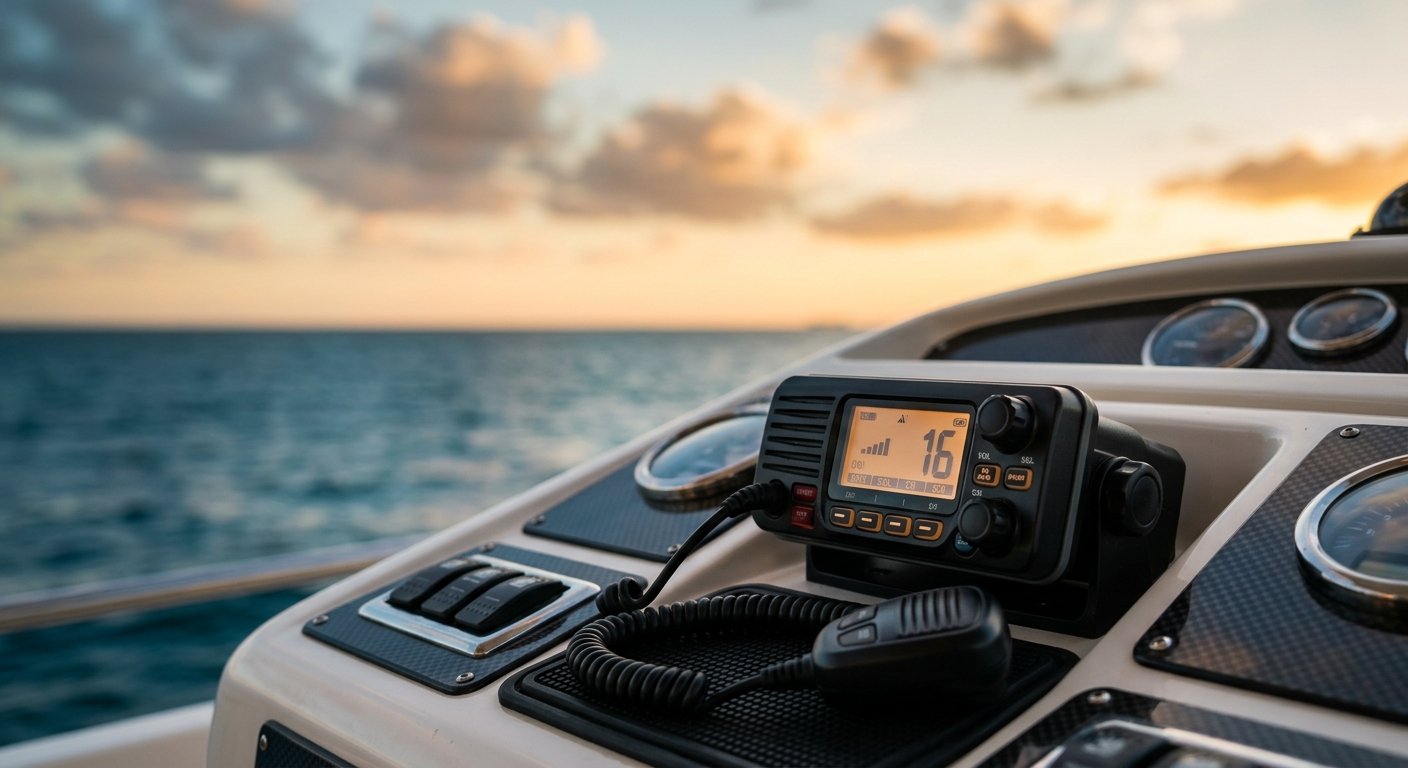
Your VHF radio is the single most critical piece of safety equipment on your vessel. It’s the first call you make to the Coast Guard during an emergency, your primary link to other vessels crossing the Gulf Stream, and your lifeline when conditions deteriorate 30 miles offshore. When it stops working—or starts working inconsistently—every trip you take carries an elevated risk that no other piece of electronics can fully compensate for.
This guide walks through the most common VHF radio failures South Florida boaters encounter, how to diagnose them, and what professional marine radio repair actually involves—including when a fix is the right call versus when replacement is the smarter investment.
Why VHF Radios Fail in South Florida Conditions
South Florida’s marine environment is exceptionally demanding on electronics. Salt air, high humidity, UV exposure, and the vibration patterns of offshore runs through Atlantic swells create conditions that accelerate equipment degradation faster than in most other boating regions.
The most common causes of VHF failure specific to South Florida boating include:
- Corrosion at connection points — Salt water intrusion at antenna connectors, power terminals, and coax splices is the leading cause of transmission and reception problems on vessels running out of Stuart, Jupiter, and Fort Lauderdale inlets.
- Antenna cable degradation — UV exposure breaks down coaxial cable insulation over time, causing signal loss and high SWR (Standing Wave Ratio) readings that damage the radio’s final amplifier stage.
- Water intrusion into the radio housing — Even radios rated IP67 can develop seal failures after years of spray exposure, particularly in open-cockpit vessels like center consoles running offshore.
- Power supply issues — Voltage fluctuations from aging batteries, poor grounding, or undersized wiring reduce output power and cause erratic performance.
- DSC (Digital Selective Calling) module failures — The DSC function, essential for automated distress alerts, is often the first component to fail when moisture enters the unit.
According to the U.S. Coast Guard Navigation Center, DSC-enabled VHF radios registered with MMSI numbers dramatically improve search and rescue response times. That makes DSC functionality not just a feature—it’s a safety imperative that should be verified regularly.
Diagnosing Common VHF Radio Problems
No Transmit or Low Power Output
If your radio appears to be transmitting but other vessels can’t hear you—or you’re getting reports of a weak, scratchy signal—the problem is almost always in one of three places: the antenna system, the coaxial cable, or the radio’s final amplifier stage. A technician can use an SWR meter to quickly isolate whether the fault lies in the antenna/cable assembly or within the radio itself.
No Receive or Poor Reception
A radio that can’t receive clearly is just as dangerous as one that can’t transmit. Poor receive performance is often caused by antenna connection corrosion or a damaged coax cable allowing interference. It can also indicate a failed squelch circuit or front-end RF amplifier inside the unit.
DSC Not Functioning or Not Registered
Many boat owners don’t realize their DSC function has never been properly registered—or has stopped functioning entirely. If your radio doesn’t have a valid MMSI number programmed and registered with the FCC, your distress calls won’t identify your vessel automatically. MMSI registration is free through organizations like BoatUS and takes minutes, but the radio itself must also be functioning correctly.
GPS Integration Failures
Modern VHF radios integrated into an NMEA 2000 network transmit your GPS position automatically with DSC distress calls. When GPS data stops feeding into the radio—due to a network fault, incorrect wiring, or a failed PGN (Parameter Group Number) configuration—your distress signal goes out without position data. This is a critical failure that requires network-level diagnostics, not just radio troubleshooting.
Intermittent Operation
A radio that works sometimes and fails other times is often a connection problem—corroded terminals, a loose coax connector, or a failing power supply. These intermittent faults are particularly dangerous because they may not appear during a marina dockside test but fail precisely when the vessel is under load, running in rough water offshore.
Marine Radio Repair: What the Process Involves
Professional marine electronics repair is considerably more involved than consumer electronics service. A qualified marine radio repair technician will systematically work through the following:
- Visual inspection — Assess corrosion, physical damage, and installation quality at the mounting location, behind the helm, and at the antenna base.
- Antenna system testing — Use an SWR meter to evaluate antenna performance and coax cable integrity. High SWR readings (above 2:1) indicate an antenna system problem that, if left unaddressed, will damage the radio’s transmitter.
- Power supply verification — Confirm the radio is receiving proper voltage under load at the unit itself, not just at the panel. Voltage drop across long wire runs is a surprisingly common problem on larger vessels.
- NMEA 2000 network check — For integrated systems, verify that GPS position data, AIS data, and other vessel information are properly flowing to the radio across the network backbone.
- DSC and MMSI verification — Confirm MMSI programming and test DSC functionality.
- Bench testing or factory service — For internal component failures, radios are evaluated for manufacturer warranty service or factory-authorized repair depending on the unit’s age and model.
Our NMEA-certified installation specialists at MEI approach every radio service call with this systematic process. A radio reinstalled on a corroded antenna cable or with an unresolved power issue is not a repaired radio—it’s a liability.
Repair vs. Replace: Making the Right Call
One of the most common questions during a marine radio service call is whether to repair the existing unit or invest in a new one. The answer depends on several factors:
- Age and model — Radios more than 8–10 years old may lack current DSC capabilities, NMEA 2000 compatibility, or AIS receiver integration. Replacing an older unit with a current model often provides a significant functional upgrade alongside the repair cost savings.
- Internal component failure — Final amplifier failures and certain board-level failures can exceed the cost of a new mid-range radio. For high-end fixed-mount radios on larger vessels, factory repair may be economical.
- System integration goals — If you’re planning to upgrade your chartplotter or add AIS, coordinating a new radio installation with those upgrades often makes more sense than repairing an incompatible older unit.
- Antenna system condition — Sometimes the antenna and coax cable are the real culprits, and the radio itself is serviceable. Replacing the antenna system and resealing connections can restore full performance at a fraction of the cost of a new radio.
Our factory-trained technicians can walk you through an honest cost-benefit analysis before any work begins. The goal is always the most reliable outcome for your safety and budget—not the highest-cost recommendation.
Proper VHF Installation Protects Your Investment
Many radio failures we service at MEI trace back to original installation shortcuts—undersized coax, improperly sealed connections, radios mounted in locations with inadequate ventilation, or NMEA 2000 networks with incorrect termination. A radio installed correctly from the start will perform significantly better and last considerably longer than one installed without attention to marine-grade specifications.
Key installation standards that matter include proper PL-259 coaxial connector installation with waterproof sealing at the antenna base, correct wire gauge and fusing for the radio’s power draw, grounding to a proper common ground bus, and NMEA 2000 backbone wiring that meets the standard’s drop length and termination requirements.
The NMEA 2000 standard specifies exact requirements for certified installations—requirements that protect both the individual devices on the network and the reliability of the overall communication and navigation system. When work is done to those standards, the entire system benefits.
If your vessel needs a new VHF installation alongside repairs to the existing system, our marine electronics installation services cover everything from single-radio replacements to complete helm communication system builds.
Frequently Asked Questions
How do I know if my VHF radio needs repair or just a new antenna?
The quickest way to determine this is an SWR meter test on the antenna system before opening the radio. High SWR (above 2:1) typically points to the antenna cable or connector, not the radio itself. Low SWR with poor performance points to the radio’s internal components. A professional technician can isolate this in minutes.
Can my VHF radio be repaired, or does it need to be replaced?
It depends on the failure type and the radio’s age. External issues—corrosion, cable damage, mounting problems—are almost always repairable. Internal amplifier or board failures on newer radios may be serviced through factory programs. For radios over 8–10 years old, replacement is often the better long-term value, especially if the unit lacks modern DSC or NMEA 2000 integration.
Why does my VHF radio work at the dock but not offshore?
This is a classic sign of an intermittent connection problem—usually a loose coax connector, corroded terminal, or marginally adequate power supply that drops voltage under vibration and load. These issues are easy to overlook at a static dockside test but become dangerous at sea. A thorough inspection under operating conditions is essential.
Do I need my MMSI number to get my radio repaired?
You don’t need it to diagnose or repair the radio, but you absolutely should have it reprogrammed correctly after any service that touches the radio’s settings or memory. MMSI registration ties your vessel identity to your DSC distress signal—without it, the Coast Guard receives a distress call with no vessel identification or GPS coordinates.
How often should my VHF radio be professionally inspected?
Annual inspection is a reasonable standard for South Florida vessels used regularly offshore. At minimum, have the antenna system and connections checked every two years. Vessels used for extended offshore passages to the Bahamas or beyond should consider pre-trip communication system verification as a standard part of departure preparation.
Schedule Your Marine Radio Service
VHF communication is not an optional system—it is your primary safety link offshore, in an inlet, or anywhere on South Florida waters. If your radio has been performing inconsistently, hasn’t been professionally inspected recently, or you’re planning a Bahamas crossing this season, there’s no better time to have it evaluated.
MEI’s licensed, insured, and NMEA-certified technicians serve boat and yacht owners from Stuart to Fort Lauderdale, including Jupiter, Palm Beach, West Palm Beach, and Hobe Sound. We work on vessels from 25-foot center consoles to mega yachts, and we bring the same standard of technical precision to every radio service call.
Contact MEI at (772) 634-6055 or visit us at 7892 SW Jack James Dr, Stuart, FL 34997 to schedule your marine radio repair or communication system inspection today.